
Meta Creates Non-Voting Class C Stock to Fund Its AI Buildout
Meta will issue one non-voting Class C share for every existing share starting in January 2027, creating a new currency to fund its AI buildout, pay talent and do deals while keeping Mark Zuckerberg's voting control intact — and raised its 2026 capital-expenditure forecast to $135–145 billion.
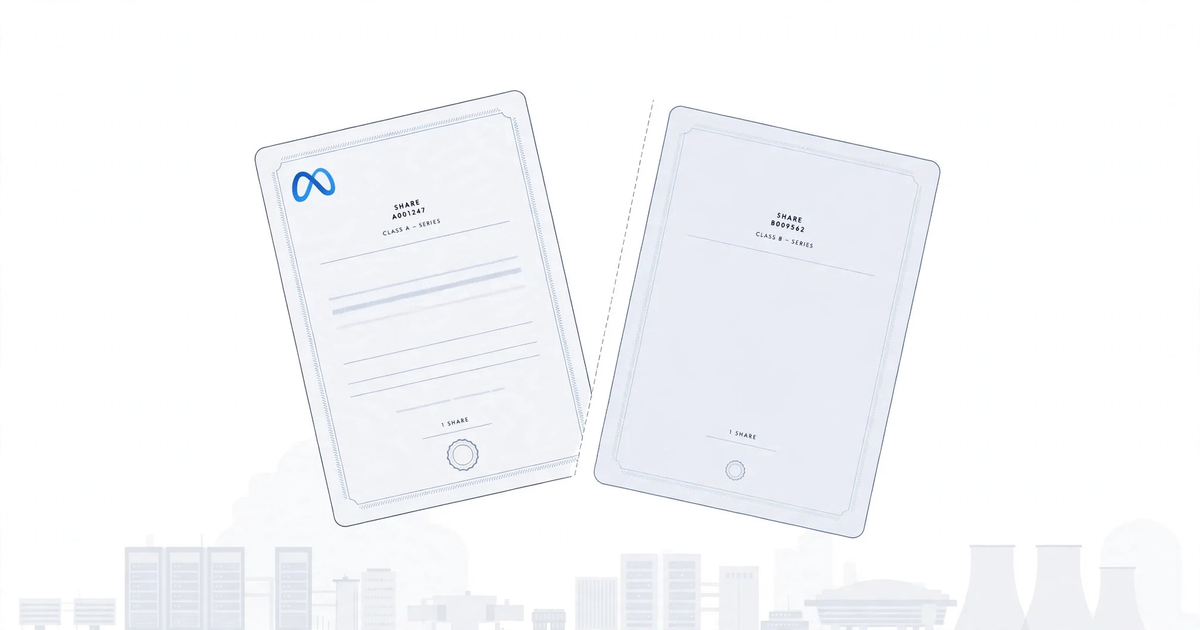
Meta is inventing a new way to pay for the AI race: print stock that carries no votes. The company’s board has approved a new class of non-voting Class C common stock, which Meta says it will use to raise capital, pay employees, and pursue acquisitions — all without diluting CEO Mark Zuckerberg’s voting control. The move, first reported by Semafor and relayed by Bloomberg, was disclosed in a filing on Wednesday, October 21.
The mechanics are simple. Meta will distribute a one-time dividend of one Class C share for each Class A and Class B share an investor holds. The company expects the dividend to affect the market price of its Class A stock the same way a two-for-one stock split would. The charter change creating the new class takes effect on January 19, 2027, and the board will pick the dividend date.
The point of the structure is control. Issuing ordinary stock to fund a spending spree would dilute Zuckerberg’s voting power over time; issuing non-voting stock lets Meta raise outside capital, hand equity to the AI researchers it is competing to hire, and pay for acquisitions, while leaving his majority control untouched. “The creation of the Class C common stock will continue the founder-led model that has driven the company’s success since its inception,” Meta said in its earnings report, as quoted by Business Insider.
The bill keeps growing
The new shares arrive alongside a bigger spending number. In its quarterly earnings report on Wednesday, Meta said it now expects 2026 capital expenditures of $135 billion to $145 billion, raising the bottom of the range from $130 billion. The forecast covers the data centers, chips, and power infrastructure behind Meta’s AI push, including its Muse assistant and the new frontier model line it has been racing to build.
The long-range picture is even larger. The filing says Meta’s internal forecasts point to capital needs of “hundreds of billions of dollars” over several years, starting as early as the autumn of 2026.
Meta has been paying for the buildout by borrowing and by halting stock buybacks. According to Quartz, its long-term debt rose by about $25 billion in the first half of 2026 alone, reaching $83.7 billion. The Class C structure gives the company a third option: fund growth with equity that costs it no votes.
A deal to keep Zuckerberg in California
The dividend is tied to a separate agreement Meta entered into with Zuckerberg on October 19, committing him to remain a California resident for eight years. Zuckerberg had told the board he was evaluating a move out of the state over a proposed wealth tax, and the agreement is designed to end that speculation.
The structure includes a carve-out for that tax bill. Meta said Zuckerberg may sell 20% of the Class C shares he receives to cover any liability from California Proposition 40, a ballot measure on the November 3 ballot that would impose a one-time 5% levy on the wealth of California residents holding at least $1 billion in assets. For each of the remaining 80% of his Class C shares that he sells, he must sell one Class A or Class B share — or convert one Class B share into Class A — a mechanism Meta says will not affect his majority voting control.
A familiar playbook
Meta is not the first tech giant to reach for this tool. In April 2014, Google executed a nearly identical maneuver: a stock dividend that created Class C non-voting shares — one for every Class A or Class B share held, effective April 2, 2014 — letting the company issue more equity while preserving the voting power of founders Larry Page and Sergey Brin. Today, Alphabet’s Class C shares trade under the ticker GOOG alongside the voting Class A shares (GOOGL), and the two prices track each other closely.
The governance mechanics are already settled, too. According to Seeking Alpha, holders of a majority of Meta’s voting power have approved the amendments to the corporate charter needed to create the new class — a vote Zuckerberg’s own holdings effectively decide. What remains is execution: the board will set the dividend date, the charter change takes effect in January 2027, and Meta will have a fresh, vote-free currency to spend on the most expensive technology buildout in corporate history.
Wall Street’s verdict: an overhang
Investors are not celebrating. The new share class creates what analysts call an overhang: a large block of future supply that hangs over the stock. Meta’s shares fell 8% after the news broke, their largest single-day drop since July, according to Reuters. The stock had climbed roughly 6.8% in extended trading on Wednesday evening after the earnings report itself, per Quartz — but the broader market reaction the following session was a selloff, as investors weighed the sheer scale of the AI buildout bill. Through Wednesday’s close, Meta shares were still up roughly 6% for the year.
The reaction captures the tension at the heart of the AI capex boom. Meta’s core advertising business remains strong, and the company argues the spending is the price of staying in the AI race. But each upward revision to the spending forecast tests how long shareholders will fund a buildout whose returns arrive years in the future. With the Class C dividend, Meta has bought itself a new way to keep spending. Whether investors keep paying for it is the open question.